
The End of Consulting? McKinsey’s AI Agents
What People Say After Going Through the Process
Published on March 16, 2026 | By Ramin J. Imani
Honest feedback from people who gained clarity, direction, and a better understanding of how to approach their job search.
The quiet reveal that says more than most people realize
The most important part of the McKinsey AI story is not that the firm uses AI. It’s that the firm appears to be redesigning consulting around it.
That distinction matters.
A lot of commentary on AI in professional services still treats the technology like a productivity layer: faster research, cleaner slides, better summaries. Useful, yes. But still additive. Still sitting on top of the old machine.
What caught my attention here is different. McKinsey has publicly described internal AI usage at a scale that feels less like tool adoption and more like operating infrastructure. The firm says active users of Lilli, its internal AI platform, have already saved two to three million hours, while engagement teams save four to six hours a week on presentations and research. McKinsey has also said only a small minority of companies have fully scaled AI enterprise-wide, which makes its own internal deployment more notable. (source: mckinsey.com)
And if you’ve spent any time around consulting, you know why that matters.
Consulting has never just been a collection of smart people. It has been a highly refined leverage model. That’s what made the industry so attractive to clients, so intense for junior talent, and so seductive for ambitious graduates who saw firms like McKinsey as career accelerators.
Now the leverage model itself looks negotiable.
That is the real story. Not “AI is coming to consulting.” Not “consultants will use better tools.” The more interesting question is whether the old bargain at the center of consulting work is starting to break.
Why this topic feels personal if you’ve grown up around prestige careers
One reason this story lands differently for early-career professionals is that consulting has long functioned as more than a job. It has been a sorting mechanism.
For a certain kind of ambitious candidate, especially in the first one to three years of a career, consulting represented the cleanest path to optionality. You worked brutal hours, learned fast, built pattern recognition, and bought yourself access to strategy, investing, operating roles, or business school later.
I’ve seen how powerful that story can be. I’ve also seen how many people quietly optimize their early careers around it, sometimes without realizing they’re optimizing for a model that may be changing faster than the recruiting brochures suggest.
That’s why this McKinsey shift is worth treating seriously. Not because it means “consulting is over,” but because it may change what the best version of a consulting career now looks like.
And once you start from that premise, the usual AI debate starts to feel too shallow.
The old consulting machine was built on a simple truth: analysis took time
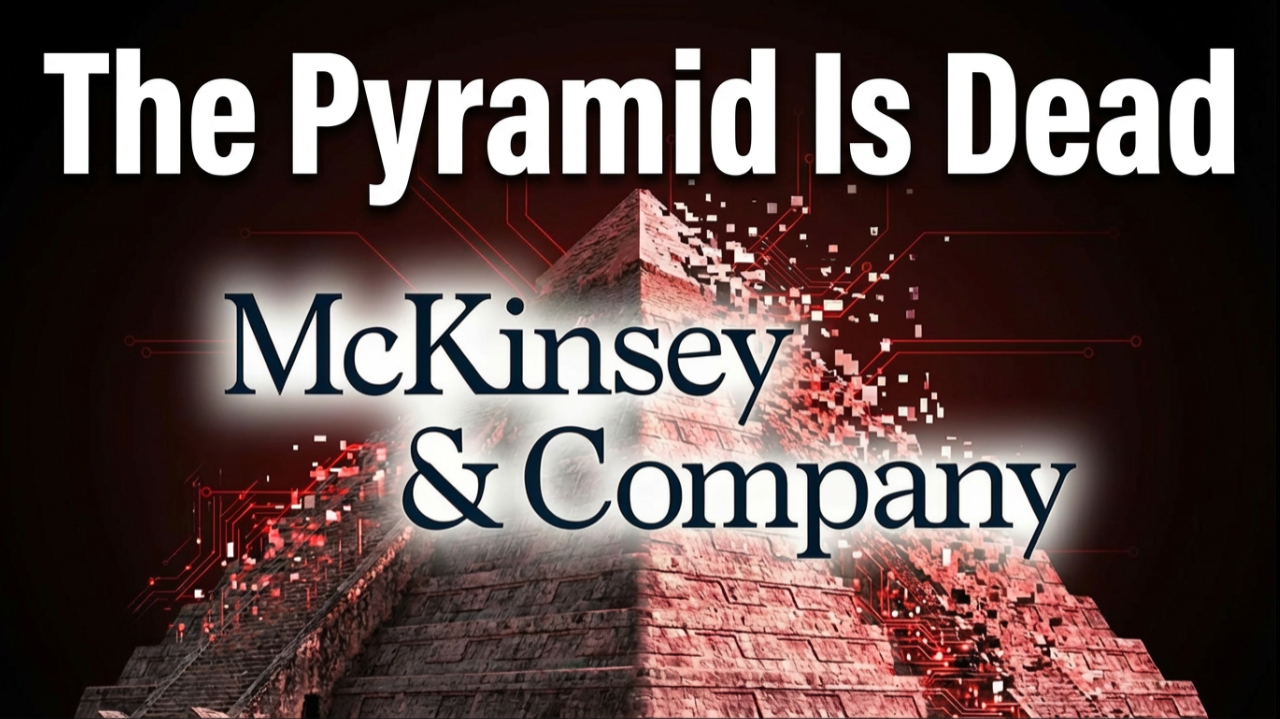
For decades, consulting firms monetized structured thinking by organizing it through a pyramid.
At the top: partners with relationships, judgment, and sales power.
In the middle: managers and principals translating client problems into workstreams.
At the bottom: analysts and associates doing the heavy analytical lifting that made the whole system run.
That bottom layer mattered more than outsiders often realized. It was not glamorous, but it was essential. Research, synthesis, benchmarking, draft storylines, working sessions, revisions at midnight, slides rebuilt again at 2 a.m. The point was never just the deck. The point was compressing ambiguity into something an executive could act on.
But the economics of that system depended on one stubborn fact: intelligence work took human time.
Once that assumption weakens, the rest of the structure starts to wobble.
And that seems to be where we are now.
McKinsey’s edge may not be the model. It may be the system around the model
This is the part many people miss. Firms do not gain durable advantage just by licensing the same model everyone else can access.
They gain advantage by building the surrounding system: the knowledge base, the workflows, the trust layer, the product discipline, the implementation capability.
McKinsey’s public signals point in exactly that direction. Lilli is not just framed as a chatbot bolted onto the side of the firm. It is embedded enough that McKinsey recently had to issue a formal statement after discovering and patching a vulnerability, underscoring how central the tool has become and how seriously the firm treats confidentiality and safeguards. (source: mckinsey.com)
That may sound like a side note, but it actually reinforces the bigger point. Once an AI system becomes core infrastructure, the conversation shifts. This is no longer “Should we experiment with AI?” It becomes “How do we govern, secure, and compound advantage from a system that is already inside the operating model?”
That is a very different level of maturity.
And it also explains why weaker firms may struggle to copy the headline without replicating the underlying engine.
The visible story is efficiency. The hidden story is pricing power
Most readers will stop at the obvious takeaway: AI helps consulting firms work faster.
True, but incomplete.
The more strategic implication is what faster work does to the commercial model.
If a meaningful share of junior-level analytical work can be accelerated, the logic of billing large teams for long cycles becomes harder to defend. That does not automatically kill time-based pricing, but it does create pressure. Clients begin asking sharper questions. Why am I paying for effort instead of results? Why am I funding process instead of speed? Why does this still require so many people?
This is where the McKinsey story becomes especially interesting for anyone in consulting, finance, or corporate strategy. The firms that win may be the ones that use AI not merely to reduce labor, but to make outcomes more predictable.
QuantumBlack matters in this context because it suggests McKinsey is not only advising on AI but productizing delivery capabilities around it. McKinsey describes QuantumBlack as its data and analytics center of excellence, with client cases tied to measurable gains such as higher output and conversion improvements. Horizon, launched through QuantumBlack, was explicitly positioned as a way to help organizations scale AI beyond proofs of concept. (source: mckinsey.com)
That is the bridge from consulting as recommendation to consulting as repeatable performance infrastructure.
And once you see that bridge, the career implications become much sharper.
What changes first is not the partner. It’s the junior pathway
Whenever AI enters a profession, the first instinct is to ask whether the senior experts are at risk.
Usually, that is the wrong question.
The first structural pressure tends to show up lower down: in the apprenticeship layer, the proving-ground layer, the part of the system where people historically learned by doing a large volume of work that now becomes compressible.
That is why early-career professionals should pay attention here.
If the old analyst role was valuable partly because it trained judgment through repetition, then AI changes both the economics and the pedagogy. There may be fewer opportunities to learn the old way. Or the same roles may remain, but with different expectations from day one.
Instead of being rewarded mainly for endurance and synthesis volume, candidates may increasingly be rewarded for three things:
1. framing sharper questions
2. pressure-testing machine-generated output
3. translating analysis into executive-grade judgment
That sounds subtle, but it is not. It changes how you prepare, what you emphasize in interviews, and how you tell your story.
If you are still positioning yourself like a high-capacity human spreadsheet, you may already be slightly behind.
The market is moving faster than many leaders admit
This broader pattern is not unique to consulting. McKinsey’s own workplace research found that employees are using generative AI more than leaders estimate, and its 2025 survey work showed AI use across organizations rising sharply while only a small fraction of companies had fully scaled it. In parallel, McKinsey has pointed to a 35 percent increase in AI-related job postings from 2023 to 2024. (source: mckinsey.com)
That combination matters.
Adoption is rising. Full-scale transformation is still rare. Hiring demand around AI fluency is growing. Which means we are in the awkward middle: not early enough to ignore the shift, not late enough that the new rules are obvious to everyone.
For ambitious professionals, that middle phase is usually where the best positioning opportunities sit.
The people who benefit are rarely the loudest “AI people.” They are the ones who can translate change into career signal before the market fully reprices it.
The real premium is moving from analysis to judgment
If I had to compress the whole shift into one line, it would be this:
In elite knowledge work, the premium is moving from producing analysis to directing it.
That does not mean analysis becomes irrelevant. It means raw analytical labor becomes less scarce on its own. What becomes scarcer is the ability to shape the question, identify what matters, and make the output credible in a boardroom, investment committee, or executive team.
That is why I would not interpret McKinsey’s AI push as “the end of consulting.”
I’d interpret it as the end of a certain version of consulting. The version where the path to value was built mainly on how many junior hours a firm could deploy beneath a client-ready narrative.
The next version is likely to feel different. Tighter teams. More system leverage. More hybrid talent. More pressure to tie recommendations to execution and outcomes. Less tolerance for elegant analysis that does not move a number.
Tactical implication for early-career readers
If you are in the first one to three years of your career, start biasing your development toward capabilities that survive compression:
build a reputation for judgment, not just output volume
get comfortable interrogating AI-generated work, not just using it
learn to connect analysis to business consequences
position yourself as cross-functional if you can: strategy plus data, finance plus product, recruiting plus operations
I’m being deliberate here and not giving the full playbook away, because this is exactly where most people either reposition intelligently or keep competing on a layer that is getting cheaper.
A simple framework: the new leverage ladder
Use this as a quick mental model.
The New Leverage Ladder
1. Access — who can access useful knowledge quickly
2. Interpretation — who can separate noise from signal
3. Application — who can turn insight into decisions and execution
4. Commercialization — who can price around outcomes, not hours
5. Career signal — who can prove they belong in this new stack
Most candidates still compete at level one or two.
The more durable advantage is higher up the ladder.
That’s also why the video matters. The real mechanics sit underneath this framework, and once you see them, a lot of seemingly disconnected career advice starts to make more sense.
Watch the full breakdown
This article is designed to frame the shift, not exhaust it.
In the full video, I go deeper on the operating logic behind McKinsey’s AI push, why it matters for the consulting leverage model, and what this signals for people still building careers around old assumptions.
Position yourself for the new consulting game
If you’re targeting consulting, strategy, finance, or high-signal lateral moves, this is exactly the kind of shift you want to interpret early, before the market fully catches up.
I work with ambitious early-career professionals on positioning, narrative, and decision-making for prestige-driven transitions.
Article FAQ
Clear answers to what McKinsey’s AI shift could mean for your consulting path and long-term positioning.
1. Are AI agents replacing consultants?
Not directly. The bigger shift is that AI is compressing repetitive analytical work, which changes how consulting firms staff projects and what they value in junior talent.
2. Why does McKinsey’s AI rollout matter for careers?
Because it signals that elite firms may increasingly reward people for judgment, problem framing, and AI-augmented execution rather than pure analysis volume.
This helps with:
1. readability
2. dwell time
3. AI search summaries
4. featured snippet

I occasionally share insights, ideas, and observations on careers and hiring
Address
Based in Stockholm, Sweden
Connect with me